
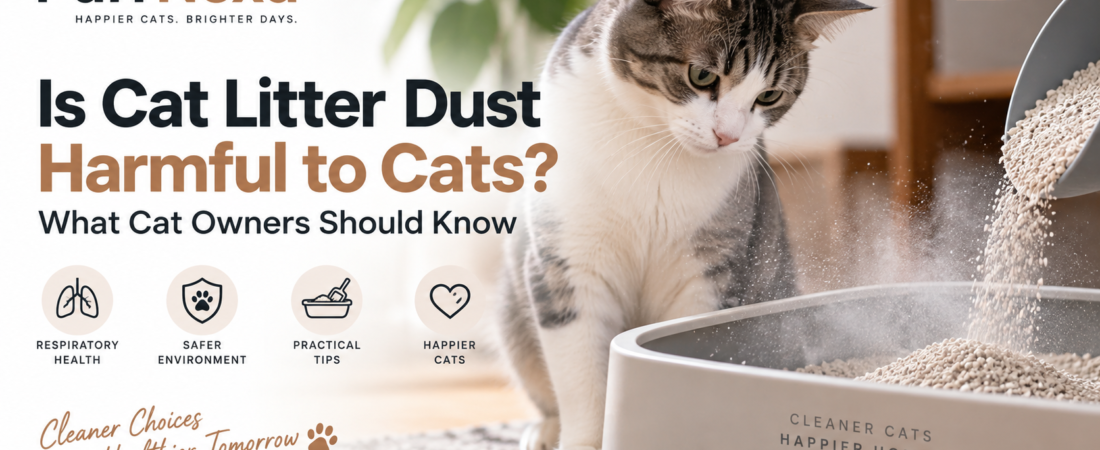
A cloud of dust rising from the litter box can be unpleasant for both cats and their owners. It may happen when pouring fresh litter, when a cat digs vigorously, or when fine particles collect at the bottom of the box.
But is cat litter dust harmful to cats?
The answer depends on the type and amount of dust, how much exposure occurs, and the individual cat. Dust from litter can act as an airborne irritant, particularly for cats that are sensitive to particles in their environment.
That doesn’t mean every dusty litter is automatically dangerous. However, reducing unnecessary airborne dust can make the litter area more comfortable for both cats and people.
Here’s what cat owners should know.
Where Does Cat Litter Dust Come From?
Cat litter is made from many different materials, including clay, silica, wood, corn, wheat, paper, and other plant-based materials.
Dust can develop when litter particles rub against one another during manufacturing, shipping, pouring, digging, and scooping.
Some products produce very little visible dust, while others can create a noticeable cloud when poured into the box.
Even a litter marketed as low-dust may still produce some fine particles during normal use.
Is Cat Litter Dust Harmful to Cats?
For many healthy cats, occasional exposure to small amounts of litter dust may not cause an obvious problem.
However, airborne particles can potentially irritate the respiratory system of sensitive cats.
The Cornell Feline Health Center lists dusty cat litter among environmental irritants that may contribute to asthma-related problems in susceptible cats.
This doesn’t mean dusty litter automatically causes feline asthma. Respiratory conditions are complex and should be evaluated by a veterinarian.
But reducing unnecessary dust is a sensible step when creating a cleaner litter box environment.
Why Some Cats May Be More Sensitive to Litter Dust
Cats spend more time close to their litter than we do.
When a cat enters the box, its nose is relatively close to the litter surface. Digging and covering waste can disturb fine particles and temporarily send them into the air.
Individual sensitivity varies.
A cat with an existing respiratory condition may react differently to airborne irritants than a healthy cat.
If your cat regularly coughs, wheezes, has difficulty breathing, or shows other respiratory symptoms, don’t assume litter is the cause. Contact your veterinarian for appropriate evaluation.
Difficulty breathing should be treated as an urgent veterinary concern.
Does Clay Cat Litter Create More Dust?
Traditional clay litter can produce dust, but the amount varies considerably between products.
Particle size, manufacturing process, packaging, transportation, and how the litter is handled can all affect how dusty it becomes.
Many modern clay litters are specifically formulated and marketed as low-dust.
Therefore, it’s more useful to evaluate the individual product rather than assuming all clay litter is equally dusty.
Is Clumping Cat Litter Dusty?
Clumping litter isn’t automatically dusty either.
Clumping describes what the litter does when it contacts moisture. It doesn’t necessarily tell you how much airborne dust the product will create.
There are both low-dust and relatively dusty clumping litters.
If you prefer the convenience of clumping litter but want to minimize airborne particles, look specifically for products designed to reduce dust.
Looking for lower-dust options?
We’ve compared several popular choices in our guide:
Best Low-Dust Cat Litter: 5 Top Picks for 2026
What About “Dust-Free” Cat Litter?
You’ll often see phrases such as:
- low dust
- dust free
- 99% dust free
- 99.9% dust free
These claims shouldn’t automatically be interpreted as meaning absolutely zero particles will ever appear.
Different manufacturers may also use different methods for describing or measuring dust.
A product marketed as extremely low-dust can still release some particles when you pour, scoop, or disturb the litter.
For practical purposes, the goal is usually to reduce airborne dust, rather than expecting every litter box to remain completely particle-free.
7 Ways to Reduce Cat Litter Dust
If litter dust is becoming noticeable around your cat’s box, a few simple changes may help.
1. Choose a Low-Dust Litter
The most straightforward solution is choosing a litter designed to produce less airborne dust.
Compare materials, particle size, clumping performance, odor control, and your cat’s preferences rather than looking at dust level alone.
See our Best Low-Dust Cat Litter comparison for several options worth considering.
2. Pour Fresh Litter Slowly
Dumping litter quickly from high above the box can create a larger cloud.
Keep the bag or container relatively close to the litter box and pour slowly.
It’s a small change, but it can noticeably reduce the amount of material thrown into the air.
3. Don’t Overfill the Litter Box
More litter isn’t always better.
An excessively deep layer gives cats more material to dig through and potentially scatter.
A practical starting point for many setups is around 2 inches of litter, although your cat’s preferences and the manufacturer’s directions should take priority.
For more detail, see:
How Deep Should Cat Litter Be? A Simple Guide
4. Scoop Regularly
Regular scooping prevents the litter box from becoming excessively dirty and reduces the need for aggressive digging through soiled areas.
Try to scoop at least daily as a practical routine, while adjusting frequency for the number of cats and boxes in your home.
See our complete guide:
How Often Should You Change Cat Litter?
5. Clean the Litter Box Regularly
Fine litter particles can accumulate on the bottom and sides of the box.
Periodic cleaning helps remove this buildup.
Use warm water and a mild, unscented soap where appropriate, rinse thoroughly, and allow the box to dry before adding fresh litter.
Our step-by-step cleaning guide explains the full process:
6. Keep the Area Ventilated
A litter box should be accessible and placed somewhere your cat feels comfortable using it.
At the same time, reasonable airflow around the litter area can help prevent odors and airborne particles from concentrating in a small enclosed space.
Avoid positioning the box where strong drafts continuously blow litter particles around the room.
7. Consider a Litter Mat
A litter mat won’t eliminate airborne dust, but it can help capture particles and granules carried out on your cat’s paws.
This can make the surrounding floor easier to maintain.
See our comparison:
Best Litter Mats for Cats: 5 Top Picks for 2026
For a practical home-cleaning routine and a quick troubleshooting checklist, see how to reduce cat litter dust at home.
Should You Switch Litter If Your Current Litter Is Dusty?
If your current litter creates a large visible cloud every time you pour or scoop it, trying a lower-dust alternative may be worthwhile.
But change litter thoughtfully.
Cats can have strong preferences for litter texture and scent. A sudden change to an unfamiliar litter may cause some cats to hesitate or avoid the box.
One approach is to introduce the new litter gradually while monitoring whether your cat continues using the box comfortably.
If your cat stops using the litter box, our guide explains several possible reasons:
Why Is My Cat Not Using the Litter Box?
Is Unscented Litter Better for Sensitive Cats?
Dust and fragrance are separate considerations.
A litter can be unscented but dusty, or scented but relatively low-dust.
For owners trying to minimize unnecessary airborne irritants around the litter box, considering both dust level and added fragrance can make sense.
Your cat’s individual preferences still matter.
See our comparison of:
Best Unscented Cat Litter: 5 Top Picks for 2026
Can Litter Dust Spread Around the House?
Yes.
Small particles can leave the litter area through several routes:
- airborne particles after pouring or digging
- litter attached to paws
- litter kicked outside the box
- particles trapped in nearby mats or flooring
Regular vacuuming or cleaning around the litter box can help keep the area tidy.
If scattered litter is your bigger problem, see:
Why Does My Cat Kick Litter Out of the Box?
Frequently Asked Questions
Is cat litter dust harmful to cats?
Small amounts may not cause obvious problems for many healthy cats, but airborne dust can act as an environmental irritant. Cats with respiratory sensitivity may be more affected. Persistent coughing, wheezing, or breathing difficulties should be evaluated by a veterinarian.
Is dust-free cat litter completely dust free?
Not necessarily. Even products marketed as low-dust or dust-free may release some particles during pouring, digging, or scooping.
Is clay litter bad for cats because of dust?
Not all clay litter produces the same amount of dust. Many modern clay products are designed to minimize airborne particles. Evaluate the individual litter rather than assuming all clay litter behaves the same way.
How can I make my litter box less dusty?
Choose a lower-dust litter, pour it slowly, avoid unnecessary overfilling, scoop regularly, periodically clean the box, and keep the surrounding area clean.
Should I change litter if my cat coughs near the litter box?
Reducing potential airborne irritants may be sensible, but coughing can have many causes. Don’t assume litter is responsible. Contact your veterinarian if coughing is persistent, recurrent, or accompanied by breathing difficulty.
Final Thoughts
So, is cat litter dust harmful to cats?
For many cats, small amounts of litter dust may not create an obvious problem. However, airborne particles can be irritating, particularly for cats that are sensitive or already have respiratory issues.
The practical goal doesn’t have to be eliminating every microscopic particle.
Instead, focus on creating a cleaner litter environment by choosing an appropriate low-dust litter, pouring it carefully, maintaining the right litter depth, scooping regularly, and cleaning the box and surrounding area.
If reducing dust is your priority, start with our comparison: