
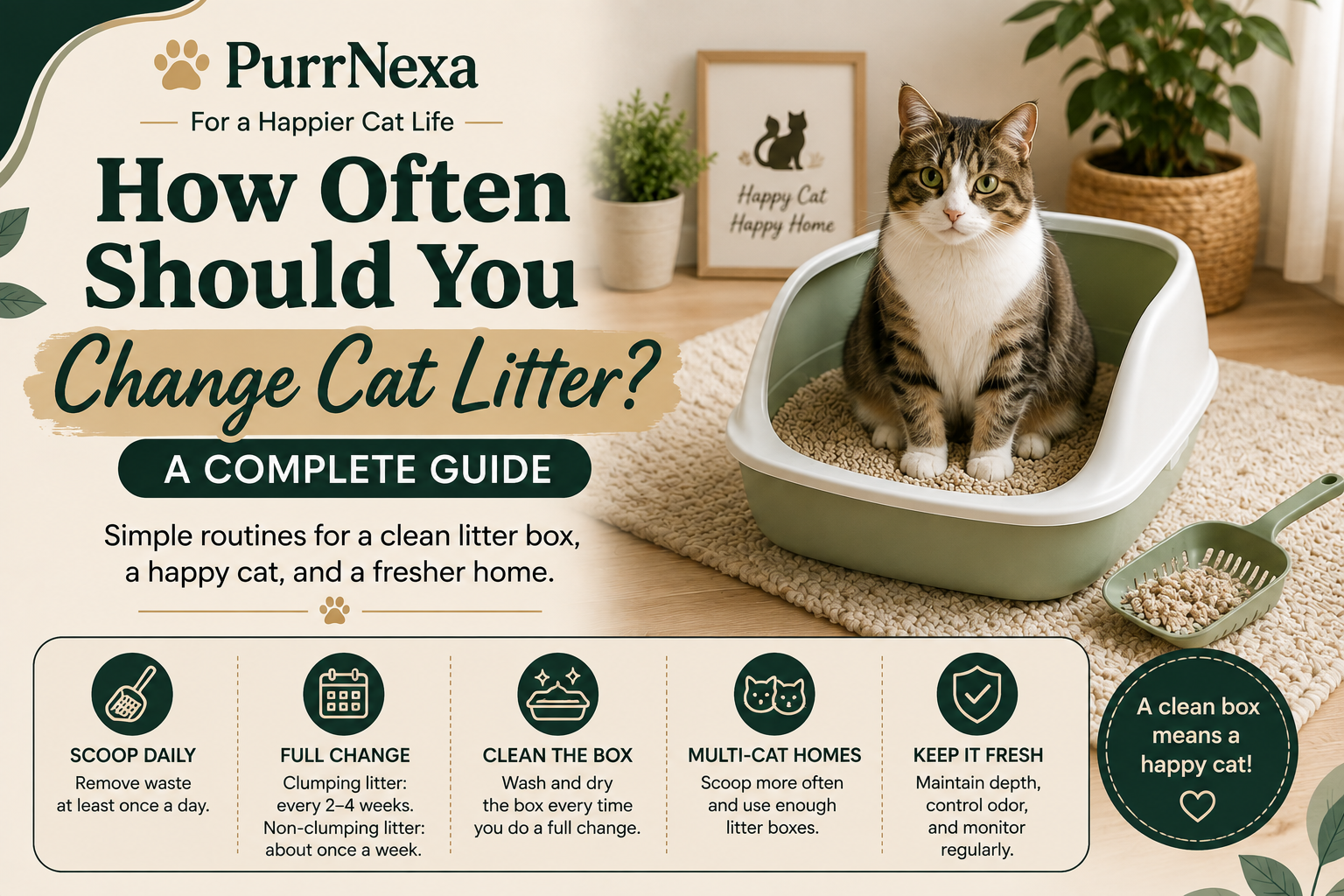
If you’re wondering how often should you change cat litter, the answer depends on the type of litter you use, how many cats share the box, and how often you scoop.
For clumping litter, you usually don’t need to empty the entire litter box every day. Regular scooping removes soiled clumps while clean litter stays in the box. Non-clumping litter generally needs more frequent full replacement because urine can remain mixed throughout the litter.
The most important thing is to keep the litter box clean enough that your cat is comfortable using it consistently.
Quick Answer: How Often Should You Change Cat Litter?
As a practical starting point:
| Litter Type | Scoop | Full Litter Change |
|---|---|---|
| Clumping litter | At least daily | Usually every 2–4 weeks, depending on use |
| Non-clumping litter | Remove solid waste daily | Often about once a week or as needed |
| Multi-cat boxes | At least daily, often more frequently | Usually more often than single-cat boxes |
| Plant-based litter | Daily | Follow the specific manufacturer’s instructions |
These are general guidelines, not fixed rules.
A litter box used heavily by multiple cats may need attention much sooner than a lightly used box for one cat. Product instructions should also take priority because litter formulas differ.
Why Regular Litter Changes Matter
Scooping and changing litter serve two different purposes.
Scooping removes urine clumps and solid waste from the litter that’s still usable.
A full litter change removes all remaining litter so you can refresh the box and clean it before adding new litter.
Doing both regularly helps manage odor, keeps waste from accumulating, and provides your cat with a cleaner place to eliminate.
It can also give you an opportunity to inspect the litter box for cracks, worn surfaces, or areas that are becoming difficult to clean.
How Often Should You Change Clumping Cat Litter?
Clumping litter is designed to form removable clumps when it absorbs urine.
Because those clumps can be scooped out, you don’t necessarily need to throw away all of the remaining clean litter each time your cat uses the box.
For many households, a reasonable routine is:
- Scoop at least once every day
- Remove solid waste and urine clumps
- Top up with fresh litter when necessary
- Completely replace the litter periodically
- Clean and dry the box before refilling
A full change roughly every two to four weeks can be a useful starting point for many clumping litters, but don’t treat that as a universal rule.
If the litter develops persistent odor, becomes difficult to scoop, stays damp, or looks heavily soiled, change it sooner.
Always check the instructions for the specific litter you’re using.
How Often Should You Change Non-Clumping Cat Litter?
Non-clumping litter works differently because urine isn’t necessarily isolated into scoopable clumps.
You can still remove solid waste daily, but urine can remain distributed through the litter.
As a result, non-clumping litter often requires more frequent complete replacement than clumping litter.
A weekly full change can be a useful starting point, but actual frequency depends on the product, litter depth, box size, and number of cats.
If odor or moisture builds up sooner, don’t wait for a scheduled day.
How Often Should You Scoop the Litter Box?
At least once daily is a sensible routine for most households.
Some litter boxes—particularly those shared by multiple cats—may benefit from scooping more than once per day.
Frequent scooping has another advantage: you remove only the dirty portions instead of allowing waste to sit in otherwise clean litter.
This can help extend the useful life of the remaining litter between full changes.
What About Multiple Cats?
More cats generally mean more litter-box use.
That means you’ll probably need to:
- Scoop more frequently
- Monitor odor more closely
- Top up litter more often
- Perform full changes sooner when necessary
Just as importantly, multiple cats shouldn’t necessarily be expected to rely on one litter box.
A commonly used guideline is one litter box per cat, plus one additional box.
So, for example:
1 cat → 2 boxes
2 cats → 3 boxes
3 cats → 4 boxes
This isn’t a rigid rule for every home, but providing multiple accessible boxes can reduce competition and give cats more options.
For litter designed for busier households, see our Best Cat Litter for Multiple Cats guide.
Signs It’s Time to Completely Change the Litter
Don’t rely only on the calendar.
Consider replacing all the litter when:
- Odor remains after scooping
- The litter looks heavily soiled
- Clumps repeatedly break apart
- The litter feels damp
- Too much fine material has accumulated
- Your cat appears reluctant to use the box
- The manufacturer’s recommended replacement interval has been reached
A schedule is useful, but the actual condition of the litter matters more.
How Often Should You Clean the Litter Box Itself?
A full litter change is a convenient opportunity to clean the actual box. Follow our step-by-step litter box cleaning guide for the full routine before refilling.
Empty the old litter and clean the box according to the litter-box manufacturer’s care instructions.
Before adding fresh litter, make sure the box is properly rinsed if necessary and completely dry.
Avoid leaving strong cleaning-product odors or residue inside the box.
Also inspect the surface of older plastic boxes. Scratches can make them increasingly difficult to clean thoroughly over time.
How Much Cat Litter Should You Put in the Box?
More litter isn’t automatically better.
The ideal depth varies by product and your cat’s preferences, so check the litter manufacturer’s instructions first.
For example, some traditional clumping litters recommend maintaining several inches of litter so cats have enough material to dig and bury waste while still allowing clumps to form properly.
After scooping, topping up the box can help maintain the appropriate depth without performing a complete litter change every time. Our guide to how deep cat litter should be explains a starting point and how to adjust it for your cat and the product.
Does Low-Dust Litter Need to Be Changed Less Often?
Not necessarily.
Dust level and replacement frequency are separate characteristics.
A litter can produce relatively little dust but still need regular scooping and periodic replacement.
Low-dust litter is primarily relevant to the amount of fine particulate matter created during pouring, digging, and scooping.
If dust around your litter box is a major concern, see our Best Low Dust Cat Litter comparison.
Does Unscented Litter Need More Frequent Changes?
Not automatically.
Unscented simply means you’re not relying on added fragrance to provide a particular scent.
An unscented litter can still contain odor-control features such as activated charcoal or highly absorbent materials.
Rather than using fragrance as an indicator of cleanliness, pay attention to actual odor, moisture, clumping performance, and the condition of the box.
See our Best Unscented Cat Litter guide if you prefer odor control without added fragrance.
How Can You Keep Cat Litter Fresh for Longer?
Good maintenance can help you get better performance from your litter without simply adding more product.
Scoop Consistently
Removing waste every day prevents dirty material from accumulating.
Maintain the Correct Litter Depth
After removing clumps, add enough fresh litter to maintain the depth recommended for your product.
Use Enough Litter Boxes
Multiple cats sharing too few boxes can make each box dirty much faster.
Keep the Area Dry
Excess moisture around the litter area can make maintenance more difficult.
Don’t Use Fragrance to Replace Cleaning
A strong scent doesn’t necessarily mean a litter box is clean.
If odor control is your biggest challenge, see our Best Cat Litter for Odor Control guide.
A Simple Cat Litter Cleaning Routine
If you want an easy routine to remember:
Every day:
Scoop urine clumps and solid waste. Check the litter level and condition.
As needed:
Top up with fresh litter to maintain the recommended depth.
Periodically:
Empty all litter, clean the box, allow it to dry, and refill with fresh litter.
Every time you clean:
Look for persistent odor, damaged surfaces, excess moisture, or anything unusual about your cat’s litter-box habits.
This is more useful than following an exact calendar while ignoring the actual condition of the box.
FAQ
How often should you completely replace clumping cat litter?
For many households, roughly every two to four weeks can be a practical starting point, provided waste is scooped daily. However, litter type, number of cats, box size, and manufacturer instructions can change that interval.
Should I scoop cat litter every day?
Yes. Daily scooping is a sensible baseline for most traditional litter boxes. Heavily used or multi-cat boxes may need scooping more frequently.
Can I just add new litter instead of changing it?
Topping up fresh litter after scooping is useful, but it doesn’t eliminate the need for periodic full changes and cleaning of the litter box.
How often should you change cat litter with two cats?
There isn’t one exact interval. Two cats generally produce more waste than one, so boxes may require more frequent scooping and full changes. Providing enough litter boxes can also prevent individual boxes from becoming overloaded.
Why does my litter box still smell after scooping?
Odor can remain when litter is saturated, small contaminated pieces remain behind, waste sticks to the box, or the box itself needs cleaning.
If persistent odor is the main problem, consider both your maintenance routine and the odor-control performance of your litter.
Should I wash the litter box every time I change all the litter?
A full litter change is a practical time to clean the box itself. Follow the care instructions for your particular litter box and make sure it is dry before adding fresh litter.
Final Takeaway
So, how often should you change cat litter?
For clumping litter, daily scooping combined with a complete change roughly every two to four weeks can be a useful starting point for many households.
Non-clumping litter often requires more frequent full replacement, while multi-cat households may need more frequent maintenance regardless of litter type.
But don’t follow the calendar blindly.
The condition of the litter, manufacturer instructions, number of cats, box usage, odor, moisture, and your cat’s behavior should ultimately determine when it’s time for a fresh box.
A consistent routine of scoop → top up → monitor → periodically replace and clean is usually more useful than trying to find one replacement schedule that applies to every cat and every litter.
Related PurrNexa Guides
Best Cat Litter for Odor Control: 5 Top Picks for 2026
Best Cat Litter for Multiple Cats: 5 Top Picks for 2026