
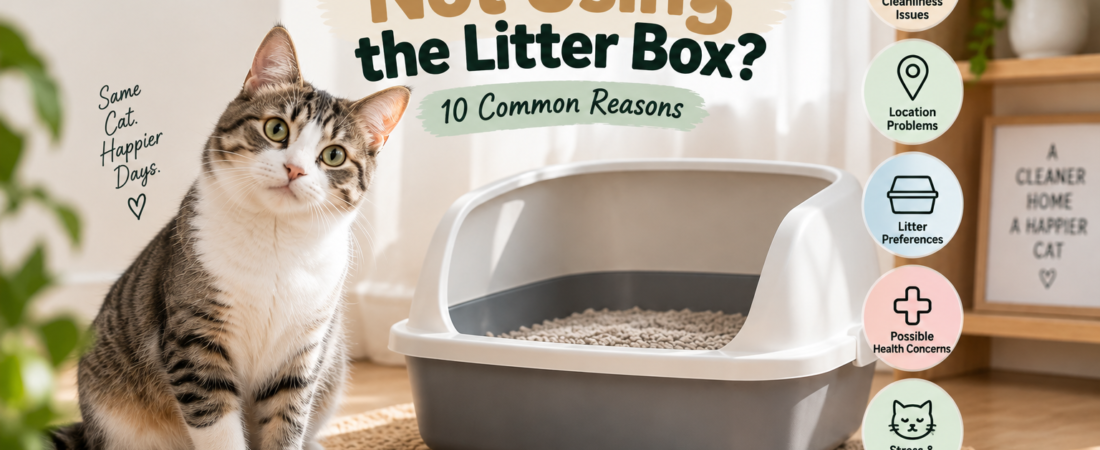
When a cat suddenly starts avoiding the litter box, it can be frustrating and confusing. You may find urine or stool beside the box, on rugs, or in other areas of the home even though your cat previously used the litter box without problems.
So, why is my cat not using the litter box?
There isn’t one universal reason. Sometimes the problem is as simple as a dirty litter box or an undesirable location. Other cats may dislike a new litter, feel uncomfortable sharing boxes, or become stressed by changes around the home.
Importantly, litter box avoidance can also be associated with health problems. A sudden change in litter box habits should therefore be taken seriously, particularly when accompanied by difficulty urinating, frequent attempts to urinate, blood, pain, or other unusual behavior.
Below are 10 common reasons a cat may stop using the litter box and practical steps you can take to improve the setup.
Quick Answer: Why Is My Cat Not Using the Litter Box?
Cats may avoid their litter boxes because of:
- A dirty litter box
- Too few litter boxes
- An undesirable box location
- A litter they don’t like
- Incorrect litter depth
- A litter box that’s too small
- An uncomfortable box design
- Conflict with other cats
- Stress or changes in the home
- A possible health problem
The best solution depends on what has changed in your cat’s environment, routine, litter box setup, or health.
Let’s look at each possibility.
1. The Litter Box Isn’t Clean Enough
Cleanliness is one of the first things to check when a cat stops using its litter box.
Cats can be particular about where they eliminate. A box containing accumulated urine clumps, stool, or strong odors may become less appealing.
Try scooping the litter box at least daily and replacing the litter when necessary.
The box itself should also be cleaned periodically rather than simply adding fresh litter indefinitely.
Our guide on how often you should change cat litter explains how scooping, topping up, and complete litter changes work together.
2. You Don’t Have Enough Litter Boxes
This is particularly important in multi-cat households.
Having several cats share a single litter box can create competition. One cat may also prevent another from comfortably accessing the box.
A commonly used starting guideline is:
One litter box per cat, plus one additional box.
That would mean three boxes for two cats, four boxes for three cats, and so on.
This isn’t an absolute rule for every household, but it provides a useful starting point.
Read our complete guide on how many litter boxes per cat you need for more information.
3. The Litter Box Is in the Wrong Location
A perfectly clean litter box can still be undesirable if it is located somewhere your cat doesn’t feel comfortable using.
Ideally, litter boxes should be placed somewhere accessible where the cat can enter and leave without feeling trapped.
Potentially problematic locations include areas that are:
- Difficult for the cat to reach
- Frequently blocked
- Extremely noisy
- Next to appliances that suddenly start
- Surrounded by heavy household traffic
- Accessible to another pet that may disturb the cat
Avoid putting every litter box directly beside the others, particularly in a multi-cat home.
From a cat’s perspective, several boxes lined up together may not provide the same choices as boxes located in different accessible areas.
4. Your Cat Doesn’t Like the Litter
If the problem began after changing litter, the new litter deserves attention.
Cats can develop preferences for litter texture, scent, and feel.
For example, switching suddenly from a fine-grained unscented litter to a strongly scented or very different material may cause some cats to hesitate.
If you recently changed products, consider whether the timing corresponds with the litter box problem.
When transitioning between litter types, a gradual change may be easier than an immediate replacement.
Our clumping vs. non-clumping cat litter comparison explains the differences between common litter styles.
You can also see our best unscented cat litter comparison if fragrance is a concern.
5. The Litter Is Too Deep or Too Shallow
More litter isn’t necessarily better.
A very deep layer can feel unstable under a cat’s paws and may encourage excessive digging and litter scatter.
On the other hand, a very shallow layer may not provide enough material for comfortable digging and covering.
A practical starting point is around 2 inches, then adjust according to your cat’s behavior, litter type, and the manufacturer’s instructions.
If your cat spends a lot of time digging or throwing litter around the box, depth may be worth adjusting.
See our full guide on how deep cat litter should be.
6. The Litter Box Is Too Small
Cats need enough room to enter the box, turn around, dig, position themselves, and cover their waste.
A box that worked well for a kitten may eventually become uncomfortable as the cat grows.
When evaluating a litter box, look at the actual interior space, not simply labels such as “large” or “XL.”
If your cat frequently stands partly outside the box, struggles to turn around, or eliminates near the edge, box size is worth investigating.
Larger boxes can also be particularly useful in homes with bigger cats.
7. Your Cat Doesn’t Like the Litter Box Design
Litter boxes come in many styles:
- Open
- High-sided
- Covered
- Top-entry
- Stainless steel
- Automatic self-cleaning
Each design has advantages for owners, but cats don’t necessarily share our preferences.
A covered box may contain litter and visually hide waste, for example, while an open box provides more airflow and easier entry and exit.
Entry height matters too.
Kittens, senior cats, and cats with mobility limitations may find a high entrance more difficult to navigate.
If litter box problems started after replacing the box itself, consider temporarily providing the previous style alongside the new one.
8. Another Cat Is Making the Box Uncomfortable
Multi-cat dynamics aren’t always obvious.
One cat doesn’t need to physically attack another to make the litter box uncomfortable.
Blocking a hallway, waiting outside the box, chasing another cat afterward, or controlling access to a particular room may be enough to discourage another cat from using it.
This is another reason why multiple boxes should ideally be distributed around the home rather than concentrated in one location.
For households with several cats, our best litter boxes for multiple cats guide covers different box styles and sizes.
9. Something in the Home Has Changed
Cats can react to changes in their environment.
Possible changes include:
- Moving to a new home
- Rearranging furniture
- A new pet
- A new person in the household
- Construction or renovation
- Changes in daily routines
- Moving the litter box
- Changing litter
- Changing the litter box itself
If the litter box problem started around the same time as a household change, consider whether your cat’s normal routine or access to the box has been disrupted.
Keeping feeding, cleaning, and litter box routines predictable may help while the cat adjusts.
10. There May Be a Health Problem
This is the most important possibility not to overlook.
Changes in litter box behavior can sometimes be associated with urinary, digestive, mobility, or other medical problems.
A cat experiencing discomfort may associate the litter box with pain or may simply be unable to reach or use it normally.
Contact a veterinarian if your cat suddenly stops using the litter box, particularly if the change persists or you notice other unusual symptoms.
Signs that deserve prompt veterinary attention include:
- Straining to urinate
- Frequent attempts to urinate with little output
- Crying or vocalizing while urinating
- Blood in the urine
- Excessive licking around the urinary area
- Visible pain or discomfort
- Significant changes in drinking or urination
- Unusual lethargy or behavior
An inability to pass urine can be a medical emergency, particularly in male cats. Seek urgent veterinary care rather than attempting to solve the problem solely by changing the litter or box.
For additional information about inappropriate elimination and litter box problems, see the ASPCA’s litter box guidance.
How to Encourage Your Cat to Use the Litter Box Again
Once urgent medical concerns have been ruled out, examine the litter box environment systematically instead of changing everything at once.
Start With Cleanliness
Scoop the box regularly and remove accumulated waste.
If the box itself has developed persistent odor or residue, clean it according to the manufacturer’s care instructions.
For additional odor-control strategies, see our guide on how to stop cat litter box smell.
Add Another Litter Box
If you currently have only one box, adding another in a different accessible location can give your cat another option.
This becomes especially important with multiple cats.
Keep the Setup Familiar
If your cat previously used a particular litter successfully, avoid unnecessary sudden changes.
When testing a new litter or box, consider offering it alongside the familiar setup instead of immediately removing the old one.
Try an Open, Accessible Box
A simple open litter box can help determine whether an enclosure, door, high entrance, or complicated design is contributing to the problem.
The box should provide enough room for comfortable movement.
Consider an Unscented Litter
Some cats may prefer litter without strong added fragrance.
If you’re troubleshooting litter box avoidance, a simple unscented option can remove one potential variable.
Keep Litter at a Comfortable Depth
Don’t continuously add litter until the box becomes excessively deep.
Start with a moderate layer and watch how your cat responds.
What Should You Avoid Doing?
Litter box accidents can be frustrating, but punishment doesn’t address the underlying reason.
Avoid:
- Yelling at your cat
- Physically punishing the cat
- Forcing the cat into the litter box
- Making several major litter box changes simultaneously
- Ignoring repeated accidents
- Assuming the behavior is simply “revenge”
Instead, treat inappropriate elimination as information that something about the cat’s health, environment, access, or litter box setup may need attention.
Should You Move the Litter Box?
Sometimes—but don’t move every box at once without considering why the current location may be failing.
If a location is noisy, inaccessible, or frequently blocked by another pet, adding a second box in a quieter area may be better than immediately removing the existing one.
If your cat has already started repeatedly eliminating in a particular appropriate area, placing an additional litter box nearby may also help while you investigate the underlying reason.
What If My Cat Pees Right Beside the Litter Box?
Urinating immediately beside the box can have several possible explanations.
The box may be too small, dirty, difficult to enter, uncomfortable, or associated with an unpleasant experience.
It can also occur with medical problems.
Don’t assume that being close to the box means the problem is purely behavioral.
If this behavior is new or repeated, veterinary advice is appropriate.
What If My Cat Poops Outside the Box but Pees Inside?
Some cats may develop different preferences for urination and defecation.
Others may find the box dirty after using it once, dislike the available space, or experience discomfort while defecating.
Providing an additional clean litter box can be a useful environmental step.
However, persistent changes in bowel habits or signs of discomfort should also be discussed with a veterinarian.
Frequently Asked Questions
Why is my cat not using the litter box all of a sudden?
Sudden litter box avoidance can result from changes in cleanliness, litter, box location, household stress, interactions with other cats, or a health problem. Because medical issues can cause sudden changes in elimination behavior, contacting a veterinarian is appropriate when the change is unexplained or persistent.
Why is my cat peeing outside the litter box but acting normal?
A cat can appear otherwise normal while still experiencing urinary discomfort or another health issue. Check the litter box environment, but don’t rely on behavior alone to rule out a medical problem.
Will a cat stop using a dirty litter box?
Some cats may avoid a litter box when waste and odor accumulate. Regular scooping and periodic cleaning can make the box more appealing and also make it easier to notice changes in urine or stool.
Should I change the litter if my cat stops using the box?
If the problem started soon after changing litter, the new texture or scent may be contributing. Consider offering the previously accepted litter again or transitioning gradually. If the change was sudden without an obvious environmental explanation, also consider veterinary advice.
How many litter boxes should two cats have?
A commonly used starting guideline is three boxes for two cats—one for each cat plus one additional box. The boxes should ideally be distributed across accessible locations rather than placed together as a single litter station.
Should I punish my cat for not using the litter box?
No. Punishment doesn’t identify or resolve the underlying cause and can add stress. Focus instead on health, cleanliness, litter preference, box design, accessibility, location, and interactions with other pets.
Final Thoughts
If you’re wondering why is my cat not using the litter box, start by looking at the entire situation rather than assuming your cat is simply misbehaving.
Check whether the box is clean, large enough, easy to access, appropriately located, and filled with a litter your cat is comfortable using. Multi-cat households should also consider whether enough litter boxes are available and whether every cat can access them comfortably.
Most importantly, pay attention to sudden changes.
Litter box avoidance can sometimes be associated with medical problems. If your cat suddenly changes its elimination habits, repeatedly strains or attempts to urinate, appears uncomfortable, or cannot pass urine, seek veterinary care promptly.
A clean, accessible, appropriately sized litter box combined with attention to your cat’s individual preferences gives you the best foundation for healthy litter box habits.
Litter box placement can also affect whether a cat feels comfortable using it. See our guide to the best place to put a litter box for practical placement tips.