
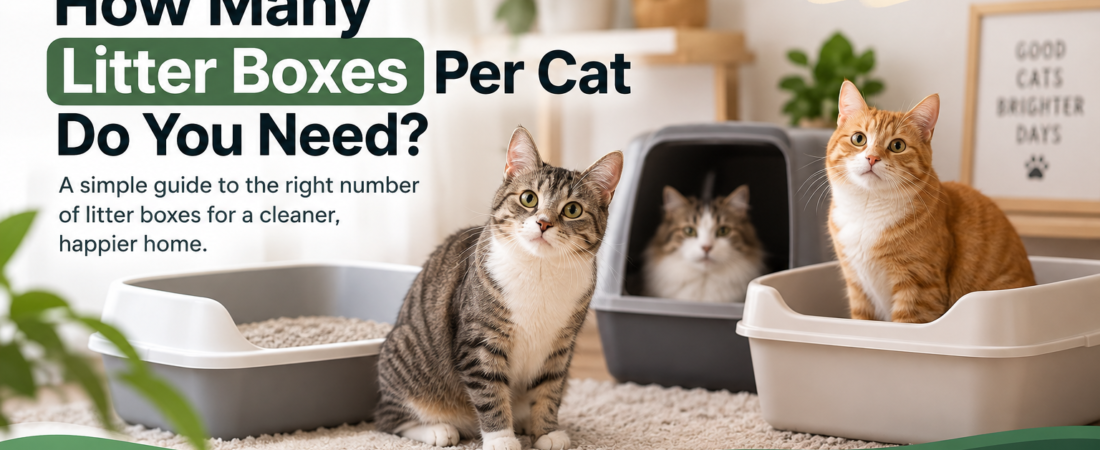
If you have more than one cat, deciding how many litter boxes to provide can quickly become confusing. Is one large box enough for two cats? Do you really need a separate box for every cat? And where should you put them all?
A commonly used guideline is one litter box per cat, plus one additional box.
That means two cats would typically have access to three litter boxes, while three cats would have four.
However, this is better treated as a practical starting point rather than a rigid rule. Your cats’ preferences, relationships, home layout, litter box size, and cleaning routine can all affect how many boxes work best.
Here is how to build a litter box setup that makes sense for your household.
How Many Litter Boxes Per Cat? The Quick Answer
The commonly recommended starting point is:
Number of cats + 1 = number of litter boxes
For example:
| Number of Cats | Starting Number of Litter Boxes |
|---|---|
| 1 cat | 2 boxes |
| 2 cats | 3 boxes |
| 3 cats | 4 boxes |
| 4 cats | 5 boxes |
| 5 cats | 6 boxes |
This doesn’t mean every household must follow the formula exactly.
Instead, the goal is to give cats enough clean, accessible options so they aren’t forced to share a single litter box.
Why Have More Litter Boxes Than Cats?
Cats can be particular about where they eliminate.
Even cats that get along well may have different preferences for litter type, box design, location, or cleanliness.
Providing multiple boxes gives them choices.
It can also prevent a situation where one dirty or occupied litter box leaves another cat without a convenient alternative.
This becomes especially useful in multi-cat homes where litter boxes accumulate waste much faster.
Can Two Cats Share One Litter Box?
They can, and some cats will happily use the same box.
But relying on only one litter box for two cats gives you very little flexibility.
If the box becomes dirty, one cat is using it, or a cat doesn’t feel comfortable approaching it, there isn’t another option available.
A better approach is to provide multiple boxes even if you notice that your cats tend to favor one particular box.
For households with multiple cats, our Best Litter Boxes for Multiple Cats guide covers larger traditional boxes designed for heavier everyday use.
Does a Huge Litter Box Count as Two Boxes?
Not really.
An extra-large litter box can provide more room and hold more litter, but it still occupies a single location.
Two separate litter boxes give cats something a single oversized box cannot: another place to go.
This distinction becomes particularly important if one cat blocks access to a box or if the preferred litter-box location becomes temporarily unavailable.
Large boxes can still be excellent for multi-cat homes. Just don’t assume that buying one enormous box automatically replaces the benefit of having multiple litter-box locations.
Where Should You Put Multiple Litter Boxes?
Placement can be just as important as the number of boxes.
Try to place litter boxes in quiet, accessible areas where cats can enter and leave comfortably.
Avoid putting every litter box directly beside the others whenever your home allows alternatives.
Three boxes lined up next to each other provide more physical capacity, but from a cat’s perspective they may function more like one litter-box area than three independent choices.
Spreading boxes between appropriate locations gives cats more options.
In a multi-story home, having litter-box access on different levels can also be more convenient than expecting a cat to travel across the entire house whenever it needs to eliminate.
Should Litter Boxes Be Covered or Open?
Either can work.
Open litter boxes generally provide easy entry, more ventilation, and a clear view of the surroundings.
Covered boxes can help contain litter scatter and give cats more visual privacy, but some cats may dislike the enclosed space.
If you’re unsure what your cats prefer, providing different designs can help you observe which boxes they actually choose.
The important thing isn’t whether a litter box looks better to us. It’s whether the cat is comfortable using it consistently.
How Big Should Each Litter Box Be?
A cat should have enough room to enter, turn around, dig, and position itself comfortably.
This is particularly important for larger adult cats.
When shopping for a litter box, don’t judge size purely from product photos. Check the actual dimensions and consider how much usable interior space remains once litter is added.
High-sided boxes can also help with cats that kick or scatter litter, although very high entry points may be inconvenient for kittens, older cats, or cats with mobility limitations.
What About Automatic Litter Boxes?
An automatic litter box can reduce routine scooping, but it doesn’t automatically change the basic need for adequate litter-box access.
A self-cleaning model may stay cleaner between uses, which can be convenient in a multi-cat household. However, cats still need to be comfortable with the machine’s size, entrance, movement, and cleaning cycle.
If you’re considering one, see our Best Automatic Litter Boxes comparison for the models we’ve researched.
You can also keep a traditional litter box available alongside an automatic model, particularly while cats are adjusting to the new setup.
How Often Should Multi-Cat Litter Boxes Be Scooped?
The more cats using a litter area, the faster waste accumulates.
As a general starting point, scoop clumping litter at least once daily, and increase the frequency when needed.
A busy multi-cat box may need attention more than once per day.
Regular scooping helps maintain usable litter and also gives you an opportunity to notice whether one box is being used significantly more than the others.
For a more complete cleaning schedule, read How Often Should You Change Cat Litter?
What If My Cats Only Use One of Their Boxes?
That’s not necessarily a problem.
Cats often develop favorite locations.
You might provide three boxes and discover that one receives much more use than the others. The less frequently used boxes still provide alternatives when the favorite box is occupied, dirty, or temporarily inaccessible.
Before removing an unused box, consider whether its location, size, litter type, or design differs from the preferred box.
Your cats may simply be telling you which setup they prefer.
Do All Litter Boxes Need the Same Litter?
Not necessarily.
Using the same litter can make maintenance and purchasing simpler, especially when your cats already accept it.
However, offering different options can sometimes help you identify a cat’s preference.
If you’re deciding between litter types, our Clumping vs. Non-Clumping Cat Litter guide explains the major differences in cleaning, odor management, and everyday maintenance.
Whatever you choose, avoid making unnecessary sudden changes to every litter box at the same time.
How to Manage Litter Box Odor in a Multi-Cat Home
More cats naturally mean more frequent litter-box use, so odor management becomes especially important.
Start with frequent scooping rather than trying to cover odors with strong fragrances.
Maintain an appropriate litter depth, replace litter when necessary, clean the boxes periodically, and keep the surrounding area reasonably ventilated.
Our guide on How to Stop Cat Litter Box Smell covers the routine in more detail.
Signs You May Need Another Litter Box
The cat-plus-one guideline is only a starting point.
Your household may benefit from another box if existing boxes become dirty unusually quickly, several cats repeatedly compete for the same location, or certain boxes are difficult for some cats to access.
Also pay attention to where your cats prefer to spend their time.
The ideal litter-box arrangement is one that provides practical options throughout the areas they can comfortably access.
If a cat suddenly stops using the litter box or develops a persistent change in elimination habits, don’t assume that adding another box will necessarily solve the underlying issue. Sudden changes can warrant professional veterinary advice.
A Simple Multi-Cat Litter Box Setup
For two cats, a practical starting setup could be:
3 litter boxes placed across 2 or 3 appropriate locations, with boxes large enough for the cats to use comfortably.
Then observe what happens.
If all three boxes are used comfortably, your setup is probably working well.
If one location is consistently avoided, investigate why before assuming you simply need more boxes.
The same principle scales to larger households: start with adequate access, observe your cats’ behavior, and adjust the arrangement when necessary.
Final Thoughts
So, how many litter boxes per cat do you need?
The simple starting point is one box per cat, plus one extra.
But the number itself isn’t the entire answer.
A good litter-box setup also considers location, accessibility, box size, cleanliness, and your cats’ individual preferences.
Two well-placed boxes can offer more useful choices than several boxes crowded into one inconvenient location.
Start with the cat-plus-one guideline, keep the boxes clean, and pay attention to which setups your cats actually prefer.
If you have several cats at home, our guide to managing cat litter with multiple cats covers cleaning, placement, odor control, and litter choice.
The number of boxes matters, but placement matters too. See our guide to the best place to put a litter box for tips on privacy, access, and multi-cat homes.
Best Litter Boxes for Multiple Cats
Best Automatic Litter Boxes
How Often Should You Change Cat Litter?
Clumping vs. Non-Clumping Cat Litter
How to Stop Cat Litter Box Smell