Choosing cat litter can seem simple until you start comparing the different types available. One of the biggest decisions is whether to use clumping or non-clumping cat litter.
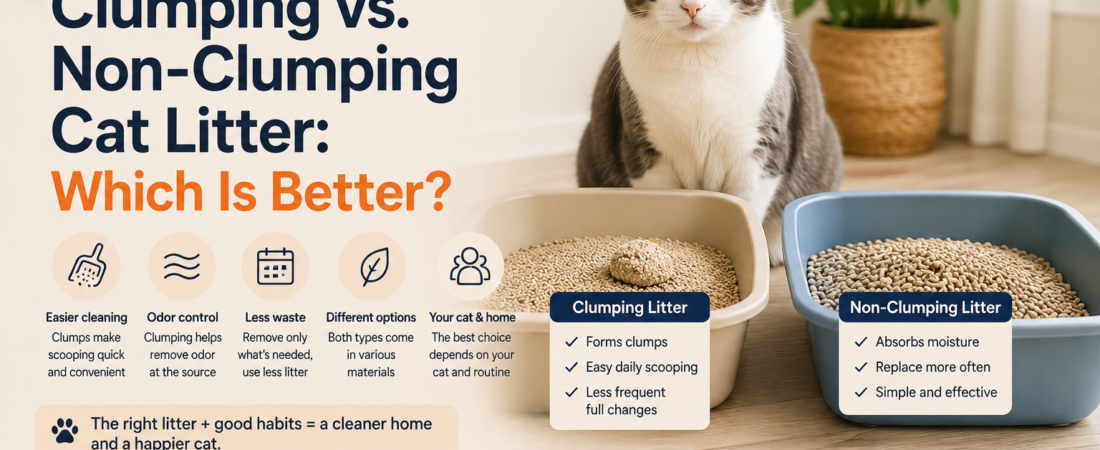
Clumping litter is designed to form removable clumps when it absorbs urine, while non-clumping litter generally absorbs moisture without creating firm clumps. Both approaches can work, but they require different cleaning routines and may suit different households.
In this guide, we’ll compare clumping vs non-clumping cat litter, including cleaning, odor control, maintenance, cost considerations, tracking, and multi-cat use.
By the end, you’ll have a clearer idea of which type may fit your cat and your litter box routine.
Affiliate Disclosure: PurrNexa may earn a commission from qualifying purchases made through links on this page, at no additional cost to you.
Clumping vs. Non-Clumping Cat Litter at a Glance
| Feature | Clumping Litter | Non-Clumping Litter |
|---|---|---|
| Urine management | Forms removable clumps | Absorbs moisture |
| Daily maintenance | Scoop urine clumps and solids | Remove solids and maintain litter |
| Full litter changes | Often less frequent | Often more frequent |
| Odor management | Waste can be removed daily | Depends heavily on absorbency and changing frequency |
| Litter usage | Clean litter can remain after scooping | Larger portions may need replacement |
| Cleanup | Usually convenient for spot cleaning | Simpler material but may require more complete changes |
| Options available | Clay and some alternative materials | Clay and various alternative materials |
| Best choice | Depends on household and cat | Depends on household and cat |
Neither type is automatically better for every cat owner. The biggest difference is how the litter handles urine and how you maintain the box.
What Is Clumping Cat Litter?
Clumping cat litter absorbs moisture and forms concentrated clumps around urine.
These clumps can then be removed with a litter scoop along with solid waste. The remaining clean litter stays in the box and can be topped up as needed.
Many clumping litters use clay materials such as sodium bentonite, although clumping formulas can also be made from other materials.
The main advantage is straightforward: you can remove urine-contaminated litter without emptying the entire box.
Advantages of Clumping Litter
Easy daily waste removal
Urine clumps can be scooped out instead of remaining distributed throughout the litter.
Convenient maintenance
Regular scooping allows much of the clean litter to remain in the box.
Potentially effective odor management
Removing urine clumps regularly removes a major source of litter box odor.
Easy to monitor litter box output
Distinct clumps can make changes in litter box use easier to notice, although litter clump size alone should not be used to diagnose a health problem.
Things to Consider
Clumping performance varies significantly between products.
Some litters form hard, compact clumps while others may break apart during scooping. Broken clumps can leave contaminated particles behind.
Fine litter can also be carried outside the box on a cat’s paws, although tracking depends on particle size, litter formulation, the litter box, and your cat.
Dust levels also vary by product rather than simply because a litter is clumping.
If dust is an important consideration, see our Best Low-Dust Cat Litter guide.
Internal link:https://purrnexa.com/best-low-dust-cat-litter/
What Is Non-Clumping Cat Litter?
Non-clumping litter absorbs urine without forming a firm scoopable clump.
Moisture is instead absorbed into the litter material. Solid waste can still be removed regularly, but urine-contaminated litter generally remains until more of the litter is replaced.
Traditional non-clumping clay litter is one example, but non-clumping products can also use materials such as wood, paper, or other absorbent materials.
Maintenance therefore works differently from clumping litter.
Rather than removing individual urine clumps, owners typically rely more heavily on the litter’s absorbency and periodic replacement.
Advantages of Non-Clumping Litter
Simple design
There is no need for the litter to create scoopable urine clumps.
Different material options
Non-clumping formats are available in several materials and textures.
May suit certain litter systems
Some litter box setups are designed around pellets or other non-clumping materials.
Potentially different tracking characteristics
Larger pellets may track differently from fine-grain litter, although performance depends on the specific product and cat.
Things to Consider
Because urine is not removed as a concentrated clump, maintenance can require more frequent litter replacement depending on the product and household.
Odor can also become noticeable if saturated litter remains in the box too long.
Manufacturer instructions are particularly useful here because recommended maintenance varies significantly among non-clumping materials.
Which Is Better for Odor Control?
For many households, clumping litter has a practical advantage: urine-contaminated litter can be removed during daily scooping.
That can help address odor at its source.
However, simply buying a clumping litter does not guarantee good odor control.
Performance also depends on:
- How frequently you scoop
- The litter’s absorbency
- Odor-control ingredients or technology
- Litter depth
- Number of cats
- Number of litter boxes
- How frequently the box is fully cleaned
A well-maintained non-clumping litter can outperform a poorly maintained clumping box.
If odor is your main concern, we’ve compared several options in our Best Cat Litter for Odor Control guide.
Internal link:https://purrnexa.com/best-cat-litter-for-odor-control/
You can also read How to Stop Cat Litter Box Smell for practical maintenance strategies.
Internal link:https://purrnexa.com/how-to-stop-cat-litter-box-smell/
Which Is Easier to Clean?
For everyday spot cleaning, clumping litter is usually more convenient.
You can scoop solid waste and urine clumps, then replace only the litter that was removed.
With non-clumping litter, solid waste is easy to remove, but urine is absorbed throughout portions of the litter. Eventually, more of the litter needs to be replaced.
However, clumping litter still requires periodic full changes and cleaning.
Scooping every day does not mean the box itself never needs washing.
Our guide How Often Should You Change Cat Litter? explains this maintenance cycle in more detail.
Internal link:https://purrnexa.com/how-often-should-you-change-cat-litter/
Which Is More Economical?
There isn’t a universal winner.
Clumping litter can allow you to remove only contaminated portions while retaining clean litter. That can reduce unnecessary disposal.
However, the actual cost depends on:
- Price of the specific litter
- Package size
- Amount used
- Number of cats
- Litter box size
- How efficiently the litter clumps
- Frequency of full changes
A cheaper bag is not necessarily cheaper over time if significantly more litter must be replaced.
For this reason, it is better to consider cost per period of use rather than simply comparing package prices.
Which Is Better for Multiple Cats?
Multi-cat households put more demand on litter.
More cats generally mean more urine, more solid waste, and more frequent maintenance.
Clumping litter can make daily waste removal convenient because individual urine clumps can be scooped throughout the day.
However, litter type alone does not solve a heavily used litter box.
Having enough litter boxes and maintaining them regularly can matter just as much.
A commonly used starting guideline is one litter box per cat plus one additional box, although the ideal setup depends on the cats and household.
For litter options aimed at heavier use, see our Best Cat Litter for Multiple Cats guide.
What About Dust and Tracking?
Neither clumping nor non-clumping automatically means low dust or low tracking.
These characteristics depend heavily on the individual product.
Fine particles may be easier for cats to carry outside the litter box, while larger particles or pellets may behave differently.
Similarly, manufacturers offer both low-dust clumping products and alternative-material litters designed around different particle structures.
If tracking is a major problem, consider the litter particle size alongside:
- Litter box design
- Entry height
- Litter depth
- Litter mat
- Your cat’s coat and paws
For dust concerns, compare products individually rather than assuming one entire litter category is dust-free.
What About Scented vs. Unscented?
Scent is a separate issue from whether a litter clumps.
Both clumping and non-clumping litters may be available in scented or unscented formulas.
Added fragrance can make a litter smell different, but fragrance should not replace regular waste removal and box cleaning.
If you prefer litter without added fragrance, see our Best Unscented Cat Litter guide.
Can You Mix Clumping and Non-Clumping Litter?
Generally, it is better to follow the manufacturer’s directions rather than assuming two different litter types should be mixed.
Combining products may change how effectively they absorb moisture or form clumps.
If you are switching litter types, a gradual transition may be useful for some cats.
For example, you can introduce some of the new litter alongside the familiar litter and gradually adjust the ratio.
However, follow the manufacturer’s instructions where applicable and pay attention to whether your cat continues using the box comfortably.
How to Choose Between Them
Ask yourself a few practical questions.
Do you want to remove urine waste every day?
Clumping litter makes that straightforward.
Are you comfortable replacing larger portions of litter periodically?
A non-clumping system may work well.
What texture does your cat reliably use?
The best-performing litter is not very useful if your cat consistently avoids it.
Is odor your biggest concern?
Look beyond the clumping label and compare odor-control features and maintenance requirements.
Do you have multiple cats?
Consider both litter performance and the number of available boxes.
Is dust or tracking a priority?
Compare specific products rather than assuming one category will solve the problem.
Clumping vs. Non-Clumping Cat Litter: Our Verdict
For many typical household litter boxes, clumping litter offers the most convenient daily maintenance because urine-contaminated litter can be removed during routine scooping.
That does not make non-clumping litter a bad choice.
Non-clumping litter can work well when its material, maintenance requirements, and litter box system suit the household and cat.
Instead of asking which category is universally best, consider:
your cat’s preference + your cleaning routine + odor-control needs + household size + the specific litter product.
That combination matters more than the label alone.
Final Thoughts
The main difference in clumping vs non-clumping cat litter is how each type handles urine.
Clumping litter forms removable clumps, making daily spot cleaning convenient. Non-clumping litter absorbs moisture without forming those clumps and generally relies more heavily on periodic litter replacement.
Whichever type you choose, consistent maintenance remains essential.
Scoop waste regularly, maintain an appropriate litter level, replace litter when necessary, clean the box periodically, and pay attention to your cat’s litter box habits.
For your next step, explore PurrNexa’s guides to the Best Cat Litter for Odor Control, Best Low-Dust Cat Litter, Best Unscented Cat Litter, and Best Cat Litter for Multiple Cats.