
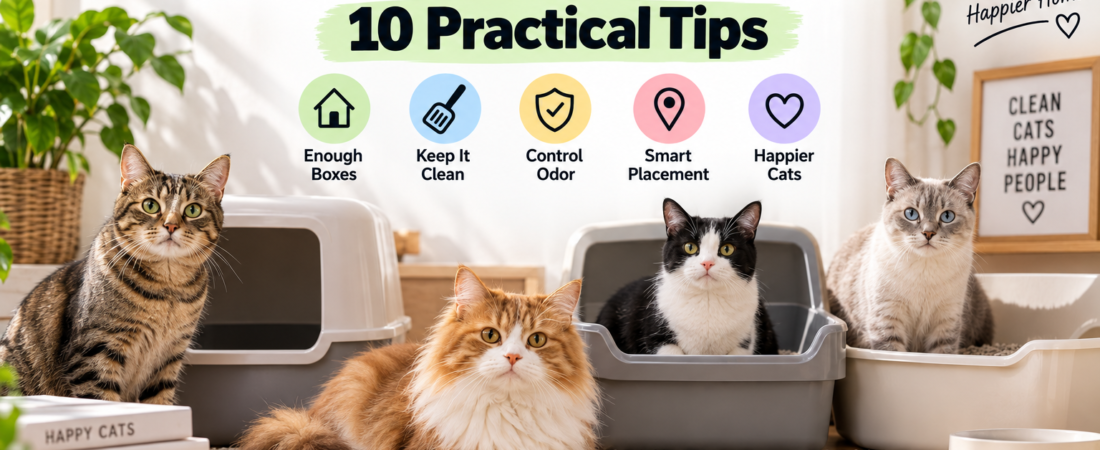
Living with multiple cats can be rewarding, but litter box maintenance becomes more demanding as the number of cats in your home increases.
Knowing how to manage cat litter with multiple cats can help you keep boxes cleaner, control odors, reduce litter scatter, and give each cat better access to a comfortable place to eliminate.
The solution is not simply buying stronger-smelling litter or scooping more often. A successful multi-cat setup depends on having enough litter boxes, choosing suitable locations, maintaining them consistently, and paying attention to your cats’ individual preferences.
Here are 10 practical ways to make a multi-cat litter setup easier to manage.
1. Provide Enough Litter Boxes
One of the most important parts of a multi-cat setup is having enough boxes.
A commonly recommended starting point is one litter box per cat, plus one additional box. For example, a household with three cats would ideally start with four litter boxes.
The American Animal Hospital Association recommends this general rule while also emphasizing that boxes should be distributed in different accessible locations, especially in homes with multiple cats.
Having additional boxes can reduce competition and gives cats another option when one box is occupied or temporarily dirty.
This does not mean every household will use every box equally. Cats may develop favorite locations, but providing choices is generally better than forcing several cats to rely on a single litter box.
Internal link: How Many Litter Boxes Per Cat?
2. Spread the Boxes Around Your Home
Four litter boxes lined up beside one another do not necessarily provide the same benefit as four boxes placed in separate locations.
In a multi-cat household, one cat may feel uncomfortable approaching a litter box if another cat frequently controls the surrounding area.
Place boxes in several quiet, accessible areas where cats can enter and leave comfortably.
Avoid locations where a cat could easily feel trapped, such as tight corners with only one exit.
AAHA specifically recommends distributing litter boxes throughout the home rather than concentrating them in one location.
For multi-story homes, having litter box access on more than one level can also make the setup more convenient for your cats.
3. Scoop More Frequently
More cats naturally mean more waste.
A box used by several cats can become dirty much faster than one used by a single cat, even when you are using high-quality clumping litter.
As a baseline, scoop every litter box at least once daily. Busy boxes may benefit from being checked more frequently.
The ASPCA recommends scooping at least once each day, while current AAHA guidance also emphasizes regular daily cleaning.
Frequent scooping helps remove both feces and urine clumps before they accumulate.
It also prevents weak or partially broken clumps from remaining mixed into clean litter.
Internal link: How Often Should You Change Cat Litter?
4. Choose Litter That Can Handle Heavy Use
Not all litter performs equally well in a busy multi-cat household.
A useful multi-cat litter should balance several characteristics: reliable clumping, odor control, manageable dust, acceptable tracking, and a texture your cats are willing to use.
Strong clumping can be particularly helpful because urine-soaked litter is easier to remove completely when the clumps remain intact during scooping.
Odor-control ingredients such as activated charcoal, carbon, absorbent clay, or baking soda may also help manage heavily used litter boxes.
However, manufacturer odor-control claims should not be treated as a replacement for regular scooping.
If you are comparing specific products, see our Best Cat Litter for Multiple Cats guide.
5. Keep Litter Depth Consistent
Adding a huge amount of litter does not necessarily make a litter box easier to maintain.
Too much litter can increase waste, encourage excessive digging in some cats, and leave more material available to be kicked outside the box.
Too little litter can make it harder for cats to dig and cover waste while allowing urine to reach the bottom of the pan more easily.
The ASPCA notes that many cats prefer a relatively shallow layer of litter, around one to two inches, although individual preferences vary.
Instead of filling the box excessively, maintain a consistent depth and top it up as clean litter is removed during scooping.
Internal link: How Deep Should Cat Litter Be?
6. Use Large Enough Litter Boxes
Litter box size becomes especially important when you have cats of different sizes.
A small box may technically hold enough litter, but that does not mean a larger cat can comfortably turn around, dig, and position itself inside.
AAHA guidance recommends considering boxes approximately one-and-a-half times the cat’s nose-to-tail length when possible.
Larger boxes also provide more usable surface area between cleanings.
For households with enthusiastic diggers, high-sided boxes can help contain scattered litter. Cats with mobility limitations, however, may need a lower entry.
If you are shopping specifically for a shared multi-cat setup, see our Best Litter Boxes for Multiple Cats comparison.
7. Control Litter Tracking Around Each Box
With several cats walking in and out of multiple boxes every day, even a small amount of tracking per visit can quickly spread litter across the floor.
Place a litter mat outside frequently used boxes to catch granules from paws.
Regular vacuuming or sweeping around litter areas can prevent those granules from spreading into other rooms.
You can also experiment with litter particle size. Larger or heavier particles may track differently than lightweight formulas, although results vary by cat and product.
If tracking is becoming the biggest cleanup problem in your home, see our Best Cat Litter for Tracking guide.
Internal link: Best Litter Mats for Cats.
8. Deep-Clean the Boxes Regularly
Daily scooping removes waste, but litter boxes still need periodic full cleaning.
When it is time for a complete litter change, empty the box and clean the surfaces before adding fresh litter.
Avoid relying on heavily scented cleaners.
AAHA recommends regular cleaning and notes that hot water is useful while strong chemicals should be avoided. The ASPCA similarly recommends mild or unscented cleaning approaches.
Allow the box to dry before adding clean litter.
Pay particular attention to areas where urine or litter residue has become stuck to the base or corners.
Internal link: How to Clean a Cat Litter Box.
9. Watch for Competition Between Cats
A litter box problem is not always a litter problem.
In multi-cat homes, social tension can affect whether every cat feels comfortable accessing the available boxes.
One cat does not necessarily need to physically attack another to create a problem. Blocking hallways, staring, chasing, or consistently occupying an area near the litter box may be enough to make another cat hesitant to approach.
The ASPCA identifies conflict between cats as one possible contributor to litter-box avoidance, while AAHA recommends providing multiple resources to reduce competition.
This is another reason litter boxes should be placed in more than one location.
Food, water, resting areas, scratching surfaces, and hiding areas should also be distributed so every cat has access to important resources.
10. Pay Attention to Changes in Litter Box Behavior
Once you know your cats’ usual litter box habits, changes become easier to notice.
A cat may suddenly begin using a different box, avoiding a particular location, eliminating outside the box, or visiting the box unusually often.
Sometimes the cause is environmental—a dirty box, a disliked litter, stress, poor placement, or competition from another cat.
However, changes in elimination behavior can also be associated with medical problems.
If a cat suddenly stops using the litter box or develops a significant change in urination or defecation habits, veterinary evaluation may be appropriate rather than assuming the problem is behavioral. The ASPCA specifically recommends ruling out medical causes when litter-box avoidance develops.
Internal link: Why Is My Cat Not Using the Litter Box?
How to Make Multi-Cat Litter Maintenance Easier
The easiest multi-cat setup is one that is simple enough to maintain consistently.
Try creating a routine where litter boxes are checked at approximately the same times each day.
Keep your scoop, waste bags or disposal system, replacement litter, and cleaning supplies close enough that maintenance does not become inconvenient.
You can also monitor which boxes receive the most use.
If one box consistently becomes dirty much faster than the others, consider whether its location is simply more attractive to your cats—or whether some of the other boxes are difficult to access.
The goal is not necessarily equal usage across every litter box.
The goal is to give every cat enough clean, comfortable choices.
Should Multiple Cats Use the Same Type of Litter?
Using the same litter across several boxes can simplify purchasing and maintenance.
However, cats can have individual preferences.
One cat may prefer a particular texture while another may be less selective.
If you are changing litter, avoid assuming every cat will immediately accept the new formula.
Providing both the old and new litter in separate boxes temporarily can help you observe which option your cats actually choose.
AAHA notes that when comparing litter types, offering separate choices can help reveal individual preferences.
For many households, an unscented clumping litter is a practical starting point, but there is no single litter that works best for every cat.
How Often Should You Completely Change Litter With Multiple Cats?
There is no universal schedule because replacement frequency depends on the litter type, number of cats, number of boxes, box size, and how effectively waste is removed during daily scooping.
Instead of relying only on a fixed number of days, monitor the condition of the litter.
Replace it when odor persists despite scooping, the litter has become excessively contaminated, clumping performance deteriorates, or the manufacturer recommends a full change.
Busy multi-cat boxes will generally require more maintenance than lightly used boxes.
Keeping enough boxes available can also distribute usage rather than forcing every cat to use the same heavily soiled box.
How Can You Reduce Litter Box Odor With Multiple Cats?
Start with waste removal rather than fragrance.
Frequent scooping prevents urine and feces from remaining in the box long enough to become a major odor source.
Then consider the litter itself.
Clumping performance, absorbency, activated carbon, charcoal, baking soda, and other odor-control technologies can help—but none eliminates the need for cleaning.
Box material can matter over time as well. Deeply scratched plastic may become harder to clean thoroughly.
For households struggling with persistent odors, see our Best Cat Litter for Odor Control comparison and our guide on How to Stop Cat Litter Box Smell.
Frequently Asked Questions
How many litter boxes should I have for two cats?
A commonly recommended starting point is three litter boxes: one for each cat plus one additional box.
Your home layout and the relationship between your cats can affect the ideal arrangement.
Can three cats share two litter boxes?
They may use them, but two boxes provide fewer options than the commonly recommended one-per-cat-plus-one guideline.
Additional boxes can reduce competition and give cats somewhere else to go when one box is dirty or occupied.
Should litter boxes be beside each other?
Usually, distributing boxes in different accessible areas provides more meaningful choices than placing every box together.
Separate locations can be particularly useful when one cat is uncomfortable around another.
What type of litter works well for multiple cats?
Look for a litter that offers reliable clumping, manageable dust, odor-control features, and a texture your cats accept.
The specific product matters more than simply choosing something labeled “multi-cat.”
Why does one litter box get used more than the others?
Cats may prefer its location, box style, litter type, cleanliness, privacy, or accessibility.
Rather than immediately removing the less-used boxes, try to understand what makes the favorite location more appealing.
Final Thoughts
Learning how to manage cat litter with multiple cats comes down to providing enough resources and maintaining them consistently.
Start with enough litter boxes, spread them throughout your home, scoop frequently, and choose a litter that performs well under heavier use.
Then pay attention to what your cats tell you through their behavior.
A successful multi-cat litter setup is not necessarily the one with the most expensive litter or equipment. It is the one that remains clean, accessible, comfortable for your cats, and realistic for you to maintain every day.
For product recommendations specifically designed around heavier litter box use, continue with our Best Cat Litter for Multiple Cats: 5 Top Picks for 2026 guide.