
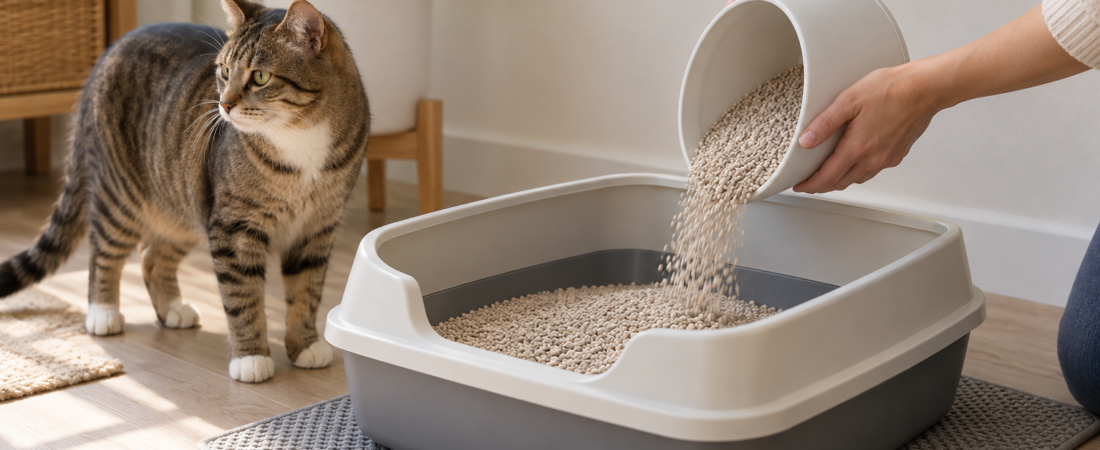
To reduce cat litter dust at home, start by noticing when it appears: while refilling, during scooping, or after your cat leaves the box. The next step might be a different litter formula, a gentler refill, or a better way to clean nearby surfaces. Buying more accessories before identifying the source can leave the same problem in place.
This guide gives you a practical routine for handling litter and cleaning the surrounding room. For a comparison of specific formulas, see our best low-dust cat litter guide.
Start With the Dust You Actually Notice
Use this quick check before changing your setup:
| What you notice | First thing to try |
|---|---|
| A cloud when you refill | Pour closer to the tray and compare the formula if the problem continues. |
| Dust when you scoop | Lift and sift gently instead of shaking the scoop vigorously. |
| Granules across the floor | Review tracking, the exit area, and your litter mat. |
| A fine film on nearby surfaces | Clean settled dust with a damp cloth and review the room’s cleaning routine. |
These are troubleshooting starting points, not product test results. Change one part of the routine at a time so you can tell what helps.
1. Observe One Refill and One Cleanup
Look at how the litter behaves during your normal routine. Does dust appear as soon as you pour, only when you shake the scoop, or mainly as residue on the floor?
Make a brief note before changing anything. A photo of the same nearby surface before cleaning can help you compare how quickly residue returns. You do not need to deliberately stir the litter or create a dust cloud to assess it.
2. Compare the Specific Litter Formula
If routine handling still produces noticeable dust, consider a formula marketed as low dust. Material alone is not enough to choose a product: compare the individual formula and consider whether your cat will accept its texture.
Unscented and low dust describe different features. Removing added fragrance does not automatically reduce dust. Cats Protection’s litter guidance recommends considering the individual product and introducing changes gradually.
Our low-dust cat litter comparison covers dust claims alongside clumping, scent, weight, and tracking. Manufacturer dust percentages should not be treated as PurrNexa test results or a guarantee about every refill.
3. Pour Close to the Box
Keep the opening of the bag or container close to the tray and pour steadily. Avoid tipping a heavy container from well above the box.
For example, Purina’s directions for one clumping litter specifically advise pouring close to the box. Check the directions on your own litter rather than assuming every product uses the same refill method.
4. Scoop Without Vigorous Shaking
Use the scoop to lift waste and let loose litter fall back through its openings with gentle movements. Repeatedly shaking a full scoop from a height disturbs more litter than necessary.
Keep the waste bag nearby so you can transfer what you remove directly. This is a handling adjustment, not a claim that changing your scoop will make a dusty formula dust-free.
5. Follow the Recommended Litter Depth
Check the package instructions when topping up. Keep enough litter for the formula to work as intended and for your cat to use the box comfortably.
Do not drastically reduce the depth just to use less litter, or fill the tray beyond the product’s directions. For a closer look at depth and different setups, read how deep cat litter should be.
6. Clean the Exit Area and Litter Mat
Granules outside the box are a tracking problem, even when they appear alongside fine dust. A mat can help contain escaped litter, but it does not filter airborne particles.
Clear the mat regularly according to its care instructions. Cats Protection suggests an easy-to-clean floor or protective mat around the tray. Compare practical options in our best litter mats for cats guide.
7. Wipe Settled Dust With a Damp Cloth
For suitable hard surfaces near the box, use a lightly damp cloth to collect the fine film. Follow the surface’s care instructions and keep cleaning moisture out of litter that is still in use.
The US Environmental Protection Agency recommends damp dusting to help prevent settled dust from returning to the air.
8. Vacuum Nearby Flooring With Suitable Filtration
If dust collects on nearby carpet or flooring, consider a vacuum with a HEPA filter. EPA notes that this can help reduce the amount of vacuumed dust escaping back into the air.
Follow the vacuum manufacturer’s instructions about debris it can handle. Use the scoop and an appropriate disposal method for used litter; a vacuum is for the surrounding floor, not a substitute for cleaning the tray. Source: EPA’s indoor particle guidance.
9. Ventilate With Clean Outdoor Air When Practical
Ventilation can support your cleaning routine when outdoor air quality and conditions are suitable. Keep the room comfortable and secure for your cat.
Avoid aiming a strong fan directly across loose litter as a way to “blow the dust away.” The practical goal is to remove the source and clean the room, rather than spread particles elsewhere. EPA’s air-cleaner guidance places source control and ventilation ahead of filtration.
10. Consider an Air Cleaner as an Optional Extra
A portable particle-filtering air cleaner may help with airborne particles in the surrounding room. Choose a unit appropriate for the room and maintain its filter as directed.
It cannot replace a suitable litter formula, careful handling, or regular cleaning. EPA notes that portable air cleaners treat a room or area and cannot remove every pollutant. Make the simpler adjustments first, then decide whether the remaining room-dust problem warrants another device. Source: EPA.
A Simple Routine to Keep
At each refill, pour close to the box and follow the package’s depth instructions. During scooping, use gentle movements and remove waste promptly. Clear escaped granules and clean dusty surfaces before residue spreads around the room.
For washing the tray itself, follow our step-by-step litter box cleaning guide. Keep a note of which adjustment you made so your next comparison is useful.
Frequently Asked Questions
Does Low-Dust Litter Mean There Will Be No Dust?
Do not assume a dust claim guarantees no visible dust during every use. Compare the manufacturer’s wording with what you observe during normal handling, and choose a formula your cat accepts.
Will a Covered Box Solve the Problem?
A cover does not change the litter formula or remove the need to clean the setup. Choose a box style your cat uses comfortably and assess the litter and handling separately.
Should I Switch Litter Overnight?
Introduce a new litter gradually. If you already provide several trays, you can offer the new litter in one while keeping the familiar option available in another. Watch your cat’s response. Cats Protection explains both approaches.
Where Can I Read About Litter Dust and Cats’ Health?
Our guide to whether cat litter dust can be harmful to cats discusses the health question separately. This article focuses on the practical home-cleaning routine.
What to Try First
Choose the step that matches your problem: a closer pour for refill clouds, gentler scooping for dust during cleanup, and careful surface cleaning for settled residue. If your normal routine remains dusty, compare specific lower-dust formulas while introducing any change gradually. Small, observable adjustments make it easier to find a setup that works for both your cat and your home.