
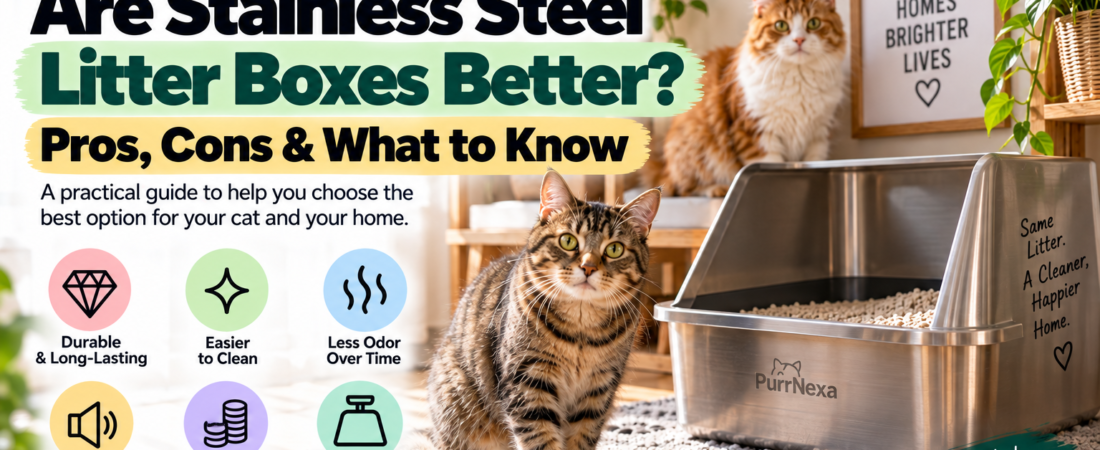
If you have been shopping for a new litter box, you may have noticed more stainless steel options appearing alongside traditional plastic boxes.
That raises an obvious question:
Are stainless steel litter boxes better?
For many cat owners, stainless steel can be a practical upgrade because it is durable, easy to clean, and less likely to retain scratches and odors over time than heavily worn plastic.
However, stainless steel is not automatically the best choice for every cat or every home.
It can cost more, feel heavier, produce more noise when your cat digs, and the design of the box still matters just as much as the material.
Here is what you should know before deciding whether a stainless steel litter box is worth it.
Quick Answer: Are Stainless Steel Litter Boxes Better?
Stainless steel litter boxes can be better for owners who prioritize durability, easy cleaning, and long-term odor management.
Compared with plastic, stainless steel has a hard, nonporous surface that does not become deeply scratched as easily during normal use.
That can make the box easier to wipe and wash over time.
However, the material alone does not determine whether your cat will like the box.
Size, entry height, box style, litter type, cleanliness, and placement can all affect whether a litter box works well for your cat.
So the better question may be:
Is a stainless steel litter box better for your particular setup?
Let’s compare the advantages and disadvantages.
Stainless Steel vs. Plastic Litter Boxes at a Glance
| Feature | Stainless Steel | Plastic |
|---|---|---|
| Durability | Generally high | Varies |
| Scratch resistance | Better | Scratches more easily |
| Ease of cleaning | Usually easy | Usually easy when new |
| Odor retention over time | Generally lower | Scratched plastic may hold odors |
| Weight | Heavier | Lightweight |
| Noise during digging | Can be louder | Usually quieter |
| Purchase cost | Usually higher | Usually lower |
| Design variety | Growing | Very wide |
| Portability | Moderate | Easy |
| Long-term use | Strong potential | May require replacement sooner |
Neither material is automatically right for every household.
Your cat’s comfort should remain the priority.
1. Stainless Steel Is Durable
One of the biggest reasons people choose stainless steel is durability.
Plastic litter boxes can work perfectly well, but repeated scratching from claws and litter scoops may eventually leave visible marks on the interior surface.
Stainless steel is harder and generally more resistant to this type of wear.
That can be useful if you have:
- A cat that digs aggressively
- Multiple cats using the same box
- A heavy-duty metal litter scoop
- A box that receives frequent daily use
- A household where you want the box to last longer
Durability is particularly appealing in multi-cat households because litter boxes can receive significantly more use each day.
However, stainless steel is not completely scratch-proof.
Abrasive cleaning tools and rough handling can still mark the surface.
2. Stainless Steel Is Easy to Clean
Cleaning is another strong advantage.
The smooth metal surface allows waste and litter residue to be removed relatively easily.
Unlike heavily scratched plastic, stainless steel does not have the same network of deep grooves where debris can become difficult to remove.
For routine maintenance, empty the litter, remove loose residue, wash the box, rinse thoroughly, and allow it to dry before adding fresh litter.
You do not need extremely strong cleaning products.
AAHA recommends regular litter box cleaning and advises avoiding strong chemicals; its litter-box guidance also emphasizes daily scooping and maintaining a clean setup.
For a complete cleaning routine, see our guide on How to Clean a Cat Litter Box.
3. Stainless Steel May Retain Less Odor Over Time
This is one of the most common reasons cat owners consider switching from plastic.
The issue is not necessarily that a new plastic litter box smells bad.
Instead, plastic can accumulate scratches over time.
Those damaged surfaces can become harder to clean thoroughly.
Stainless steel provides a hard, relatively smooth, nonporous surface that is less likely to develop the same deep claw marks.
That can make long-term odor management easier.
However, it is important to keep expectations realistic.
A stainless steel litter box will not eliminate litter box odor.
Urine, feces, dirty litter, and insufficient cleaning can still produce strong odors regardless of the box material.
Daily scooping remains more important than simply switching from plastic to steel.
If odor is your main concern, see our guides to How to Stop Cat Litter Box Smell and Best Cat Litter for Odor Control.
4. Stainless Steel Does Not Need to Be Replaced Just Because It Gets Scratched Easily
Plastic litter boxes are inexpensive and widely available, but they are still consumable household items.
Over time, owners may replace them because the surface becomes heavily scratched, stained, damaged, or difficult to clean.
A well-made stainless steel box has the potential to remain usable for much longer.
This can partially offset the higher purchase price.
Instead of comparing only the initial price, consider how long you expect to keep the box.
A more expensive box that lasts several years may provide better long-term value than repeatedly replacing cheaper alternatives.
Actual lifespan will still depend on material quality, construction, cleaning methods, and daily use.
5. Stainless Steel Is Heavier
Extra weight can be either an advantage or a disadvantage.
A heavier box may feel more stable while a cat is digging or entering and leaving.
It is also less likely to shift across smooth flooring as easily as an extremely lightweight plastic tray.
However, that same weight makes the box more difficult to move.
This matters when:
- Carrying the box to a bathroom for cleaning
- Moving it between floors
- Emptying large amounts of litter
- Rearranging your cat’s setup
- Cleaning underneath the box
Once a stainless steel box contains several inches of litter, the combination can become surprisingly heavy.
If portability matters to you, consider this before choosing an oversized model.
6. Stainless Steel Can Be Noisier
This is one disadvantage that is easy to overlook.
When a cat scratches the bottom or sides of a metal litter box, its claws can produce a noticeable scraping sound.
A metal litter scoop may also create more noise against stainless steel than against plastic.
Some cats may not care.
Others may be more sensitive to unfamiliar sounds.
If your cat is nervous around sudden noises or has strong preferences about its litter box, introduce the new box gradually rather than immediately removing every familiar option.
Cat preferences matter.
AAHA notes that cats can have individual preferences regarding litter boxes and litter types, while the ASPCA also identifies litter-box type and location as potential factors in litter-box avoidance.
7. Stainless Steel Boxes Usually Cost More
A basic plastic litter tray can be inexpensive.
Stainless steel models generally cost more upfront, particularly larger versions with high sides, removable enclosures, lids, or specialized designs.
Whether the extra cost is worthwhile depends on what you want from the box.
You may value stainless steel more if your current plastic boxes:
- Become scratched quickly
- Need frequent replacement
- Hold persistent odors
- Are difficult to clean
- Receive heavy multi-cat use
If none of those issues bother you, a good plastic litter box may continue to work perfectly well.
You do not need to replace a box simply because another material exists.
8. Box Size Matters More Than Material
A beautifully made stainless steel litter box can still be a poor choice if it is too small.
Your cat needs room to enter, turn around, dig, eliminate, and cover its waste comfortably.
The 2021 AAHA/AAFP guidance recommends a litter box at least one-and-a-half times the cat’s length from nose to tip of tail.
That means dimensions matter more than a label such as:
- Large
- XL
- Jumbo
- Extra large
Check the actual measurements before buying.
Also pay attention to how much interior space is lost when a box includes:
- High-side attachments
- Lids
- Entry platforms
- Splash guards
- Internal seams
A slightly larger open stainless steel tray may provide more usable space than a bulky enclosed model with similar exterior dimensions.
9. Entry Height Matters Too
High sides can be useful.
They can help contain litter when a cat digs enthusiastically and may reduce urine spray reaching nearby walls.
But high sides can also make entry harder.
This can be especially important for:
- Kittens
- Senior cats
- Cats with limited mobility
- Cats recovering from injury
- Cats that simply prefer easier access
AAHA specifically notes that litter box sides should not be too high for kittens and older cats that may have difficulty entering or leaving.
When shopping for stainless steel boxes, check whether the entrance has a lower cutout even if the remaining walls are tall.
10. High-Sided Stainless Steel Boxes Can Help With Litter Scatter
Some stainless steel boxes include tall removable walls around the metal base.
This can be useful for cats that aggressively dig or kick litter outside the box.
The high sides provide a physical barrier while still allowing you to use a durable stainless steel base.
That said, high sides do not eliminate tracking.
Litter can still stick to paws and travel outside the box.
A litter mat positioned outside the entrance can help capture some of those loose granules.
For particularly messy diggers, see our guide on Why Does My Cat Kick Litter Out of the Box?
You can also compare our Best Litter Mats for Cats.
Are Stainless Steel Litter Boxes More Hygienic?
Stainless steel has properties that make it practical to clean, but it is better not to treat the material itself as a substitute for good litter box hygiene.
A dirty stainless steel box is still a dirty litter box.
Daily scooping and periodic full cleaning remain essential.
The main hygiene advantage is practical:
A smooth, durable surface may remain easier to clean over time than heavily scratched or degraded plastic.
Good litter box hygiene still depends on:
- Removing waste regularly
- Maintaining suitable litter depth
- Replacing dirty litter when needed
- Washing the box
- Keeping the surrounding area clean
The material helps make maintenance easier—it does not perform the maintenance for you.
Do Stainless Steel Litter Boxes Smell Less?
They may be easier to keep odor-free over long-term use, but they do not prevent odors from forming.
Most litter box odor comes from the contents of the box.
That means the biggest factors remain:
- How frequently you scoop
- How many cats use the box
- The litter’s absorbency
- Clumping performance
- The amount of clean litter available
- How frequently the box is fully cleaned
The advantage of stainless steel becomes more noticeable when comparing an intact metal surface with an older plastic box covered in scratches and difficult-to-clean areas.
If your relatively new plastic litter box is cleaned frequently and does not retain odor, changing materials may produce less dramatic improvement than expected.
Do Cats Prefer Stainless Steel Litter Boxes?
There is no reason to assume every cat prefers stainless steel.
Many cats are likely more concerned with other aspects of the setup, including:
- Box size
- Litter texture
- Litter depth
- Cleanliness
- Location
- Entry height
- Open versus covered design
- How safe the area feels
The material may matter less to your cat than it does to you.
This is why changing everything at once can sometimes cause problems.
If you are replacing a familiar plastic box with stainless steel, consider placing the new box nearby temporarily while keeping the original available.
Let your cat choose.
Are Stainless Steel Litter Boxes Good for Multiple Cats?
They can be particularly useful in multi-cat homes because they are durable and relatively easy to maintain.
However, buying one very durable stainless steel box does not replace the need for enough litter boxes.
A commonly recommended starting guideline is one litter box per cat, plus one additional box.
AAHA and ASPCA both recommend providing multiple boxes and distributing them in accessible locations rather than forcing several cats to depend on one area.
For a complete setup, read our guide on How to Manage Cat Litter With Multiple Cats.
Stainless Steel Litter Box Pros
The main advantages include:
- Durable construction
- Resistant to deep scratching during normal use
- Smooth surface that is easy to clean
- Less likely to retain persistent odors as the surface ages
- Good option for frequent use
- Available in increasingly large sizes
- Many models include high sides
- Potential for longer service life than inexpensive plastic boxes
Stainless Steel Litter Box Cons
Potential disadvantages include:
- Higher upfront cost
- Heavier than plastic
- Can be noisy when cats scratch the surface
- Metal scoops may create additional noise
- Fewer designs than plastic
- Some high-sided models may have difficult entry points
- The metal surface can feel different to cats accustomed to plastic
- Stainless steel quality varies between products
The ideal choice depends on which of these factors matters most in your home.
Stainless Steel vs. Plastic: Which Should You Choose?
Choose stainless steel if your priorities include:
- Long-term durability
- Easier cleaning
- Reducing problems with heavily scratched surfaces
- A sturdy box for frequent use
- High-sided designs
- Multi-cat durability
Plastic may still be a better choice if you prioritize:
- Lower cost
- Lightweight construction
- Easier portability
- A very specific box shape
- Maximum selection
- A familiar material your cat already accepts
There is nothing inherently wrong with a plastic litter box that is appropriately sized, kept clean, and comfortable for your cat.
Stainless steel is simply another option with several practical advantages for owners.
What Should You Look for in a Stainless Steel Litter Box?
Before buying one, check more than the material.
Size
Choose a box with enough interior space for your cat to move comfortably.
Entry Height
Look for a lower entrance if your cat has limited mobility.
Side Height
High walls can help contain litter and urine spray but should not make entry difficult.
Construction
Check whether detachable walls, lids, and connectors feel stable.
Interior Design
Smooth corners and simple shapes tend to make cleaning easier.
Weight
Consider how heavy the box will become after adding litter.
Open or Enclosed Design
Some cats prefer open boxes, while an enclosure may help contain litter in certain households.
Placement
Even the right litter box can become undesirable if placed somewhere noisy, inaccessible, or uncomfortable.
See our guide to the Best Place to Put a Litter Box for placement tips.
When Is a Stainless Steel Litter Box Worth It?
It may be worth considering if you have already experienced problems with plastic boxes becoming:
- Deeply scratched
- Difficult to clean
- Permanently stained
- Smelly even after cleaning
- Damaged from long-term use
It can also make sense if you simply want a sturdy litter box you expect to keep for several years.
However, switching materials should not be the first response to every litter box problem.
If your cat suddenly starts eliminating outside the box, seek veterinary advice promptly to check for underlying medical problems, as recommended in the AAHA/AAFP guidance. Also review cleanliness, location, litter choice, accessibility and stress rather than assuming the box material is responsible.
Frequently Asked Questions
Are stainless steel litter boxes worth the money?
They can be worth the additional cost if durability, easier cleaning, and long-term use are priorities. Whether the value makes sense depends on how frequently you would otherwise replace plastic boxes.
Do stainless steel litter boxes hold urine odors?
The stainless steel surface itself is relatively nonporous and easy to clean, but urine and dirty litter can still smell. Regular scooping and cleaning remain necessary.
Do cats scratch stainless steel litter boxes?
Yes. Cats may scratch the sides or bottom while digging and covering waste. Stainless steel generally handles this type of contact well, although scratching can create more noise than with plastic.
Can stainless steel litter boxes rust?
Quality stainless steel is designed to resist corrosion, but resistance varies with the grade of steel, construction quality, exposure, and cleaning products. Avoid highly abrasive or inappropriate cleaners and follow the manufacturer’s care instructions.
Are stainless steel litter boxes good for large cats?
They can be, provided the box itself is large enough. Do not assume a stainless steel model is spacious simply because it is labeled XL.
Are stainless steel litter boxes good for senior cats?
Potentially, but entrance height is important. A tall-sided box without a low entry may be difficult for a cat with reduced mobility.
Should I replace my plastic litter box with stainless steel?
Not necessarily. If your current box is appropriately sized, easy to clean, in good condition, and accepted by your cat, there may be no urgent reason to replace it.
Final Thoughts
So, are stainless steel litter boxes better?
For many households, they offer meaningful advantages in durability, cleaning, scratch resistance, and long-term maintenance.
But stainless steel alone does not make a good litter box.
A box still needs to be large enough, easy to enter, kept clean, filled with litter your cat accepts, and placed somewhere your cat feels comfortable using it.
If those fundamentals are already covered, stainless steel can be a very practical upgrade from a worn plastic box.
If you are ready to compare specific options, see our Best Stainless Steel Litter Boxes: 5 Top Picks for 2026 guide.